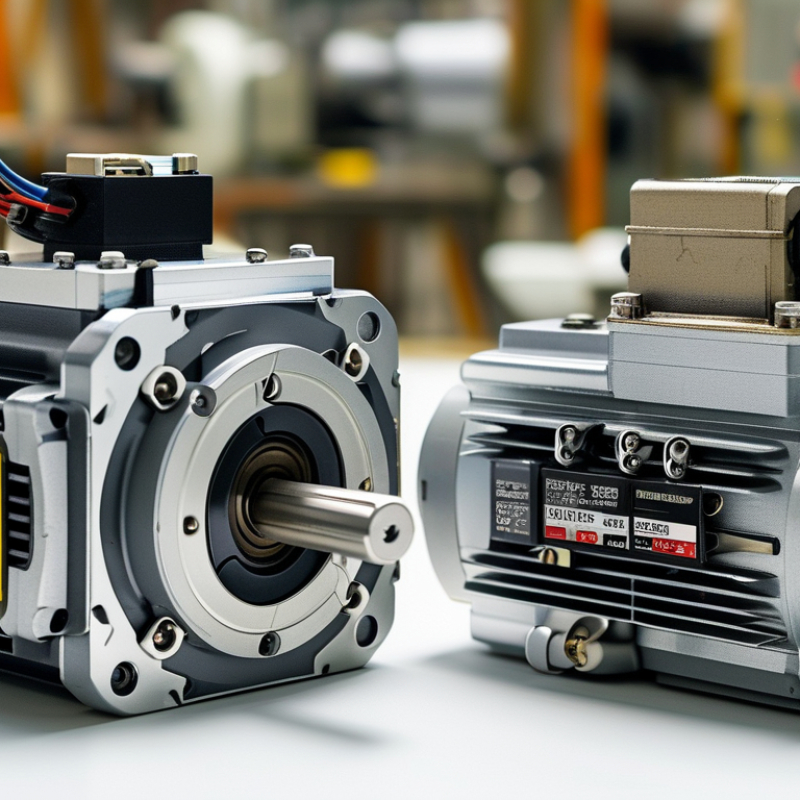
Choosing the right motor with encoder can be challenging. There are various factors to consider. An encoder is crucial for precise control and feedback in applications.
When selecting a motor with encoder, think about your specific needs. Different motors serve different purposes. For instance, applications requiring high accuracy will benefit from certain encoder types. However, not every motor with encoder will fit your requirements perfectly.
The variety of options can overwhelm you. Each motor comes with unique specifications and features. You might face challenges in understanding technical terms or specifications. It's essential to reflect on your project's goals before making a decision. Taking the time to evaluate your needs will lead to better outcomes.
Understanding the Basics of Motors and Encoders
Understanding motors and encoders is essential for efficient automation. Motors convert electrical energy into mechanical energy. They can be classified into various types, such as stepper and servo motors. According to a recent industry report by MarketsandMarkets, the global electric motor market is projected to reach USD 105 billion by 2026, highlighting the growing importance of these components.
Encoders are crucial for providing feedback on a motor's position or speed. They can be incremental or absolute, each serving different functions. An incremental encoder gives feedback by counting pulses, while an absolute encoder provides unique position values. A report from Allied Market Research states that the encoder market is expected to grow at a CAGR of 6.7% from 2020 to 2027, driven by advancements in automation.
Choosing the right motor and encoder depends on specific application requirements. For example, applications requiring accurate positioning might benefit more from servo motors paired with absolute encoders. However, in cases where cost efficiency is key, stepper motors with incremental encoders may suffice. It’s vital to reflect on these details to ensure the chosen components meet performance and reliability standards.
How to Choose the Right Motor With Encoder for Your Needs?
| Motor Type |
Encoder Type |
Voltage (V) |
Torque (Nm) |
Speed (RPM) |
Resolution (PPR) |
| DC Motor |
Incremental |
12 |
0.5 |
3000 |
500 |
| Stepper Motor |
Absolute |
24 |
1.2 |
1500 |
1000 |
| Servo Motor |
Incremental |
48 |
2.5 |
2000 |
2000 |
| BLDC Motor |
Incremental |
36 |
1.5 |
4000 |
750 |
Identifying Your Specific Application Requirements
When selecting a motor with an encoder, understanding your application's specific requirements is essential. Different applications demand varying performance characteristics. For instance, some may need high-speed capabilities, while others prioritize torque or precision. Identifying the required torque and speed ratings ensures you choose a motor that meets your needs effectively.
Consider the operating environment as well. Factors like temperature, humidity, and potential exposure to contaminants can affect motor performance. A motor in a dusty environment may require a different design than one in a clean, climate-controlled space. This insight helps prevent future issues that arise from improper selection.
Finally, don't overlook the importance of feedback from real-world use. Gathering insights from similar applications can guide your decision-making. Engage with professionals who have experience in the field. Their experiences will provide valuable context that can clarify your needs. Remember, even minor details matter. Choosing the wrong motor can lead to inefficiencies. Therefore, take the time to assess your specific requirements carefully.
Motor Selection Criteria Analysis
Evaluating Motor Types and Their Suitability
When evaluating motor types, it’s essential to understand the specific application requirements. There are generally three types of motors used: stepper motors, servo motors, and brushed or brushless DC motors. According to industry research, servo motors are favored for high precision and control, making them suitable for robotics applications. In contrast, stepper motors, with their discrete steps, are often used in 3D printing. Each motor type has advantages and drawbacks that can impact performance.
The choice of encoder can also greatly influence the motor efficiency. For high-resolution tasks, absolute encoders provide precise positioning. Incremental encoders, however, are cost-effective for applications not requiring extreme accuracy. A study indicated that using the appropriate encoder can improve motor performance by as much as 30%. It's vital to assess the environment where the motor will operate, as temperature and load conditions can affect both motor and encoder functionality.
Consider the mounting options and space limitations as well. A compact design may limit motor selection and complicate installation. Some designs may not accommodate the necessary encoder for feedback. Users must reflect on the reliability and maintenance requirements of the chosen motor system. Not all options are equally durable; regular wear and tear can lead to operational failures if not properly managed.
Selecting the Right Encoder for Precision and Performance
When selecting the right encoder for your application, precision is key. Encoders transform mechanical motion into electrical signals. Two main types are incremental and absolute encoders. Incremental encoders provide relative position feedback. They require a reference point after power is cycled. Absolute encoders give a unique position value at all times. This makes them reliable in critical applications.
Understanding the performance you need is essential. Resolution defines how precise the encoder can be. Higher resolution means more detailed position feedback. Look for encoders that meet your accuracy requirements. Think about the environment too. Temperature fluctuations can affect performance. Choosing an encoder resistant to these changes ensures reliability over time.
Sometimes, it’s easy to overlook the interface and connectivity options. Ensure compatibility with your motor and control systems. Different encoders offer various output formats. Some offer simple quadrature signals. Others provide more complex data, like serial communication. Taking these factors into account helps avoid future complications. Adjustments may be needed after initial installation. Reflecting on these small details will improve the overall setup process.
Integrating Motors and Encoders for Optimal Functionality
Integrating motors and encoders is essential for enhancing system performance. Motors provide the necessary movement, while encoders track position and speed. This combination ensures precision and reliability in various applications, from robotics to industrial automation. When selecting components, consider the encoder's resolution alongside the motor's capabilities. High-resolution encoders deliver more accurate feedback, which is vital for delicate operations.
Choosing the right motor often involves balancing torque and speed. However, it is equally important to factor in how the encoder communicates with your control system. Some encoders are incremental, while others are absolute. Incremental encoders are often simpler but can lose track in power failures. Absolute encoders offer consistent positioning, even after interruptions.
When integrating these components, assess your specific needs and environment. Environmental factors may affect performance, such as dust or temperature variations. Be prepared to troubleshoot common issues, like signal interference or mounting misalignments. Identifying potential shortcomings early can lead to more robust designs that excel under real-world conditions.
FAQS
: Precision is crucial. Choose between incremental and absolute encoders based on your application.
Incremental encoders provide relative feedback and need a reference. Absolute encoders always give a unique position.
Higher resolution leads to more detailed position feedback. This is essential for accuracy in applications.
Temperature fluctuations and dust can impact reliability. Choosing a resistant encoder is important for long-term use.
Ensure compatibility with motors and control systems. Different encoders use various output formats.
Be ready to troubleshoot signal interference and mounting misalignments. Identifying issues early helps improve designs.
Initial setups may require tweaks for optimal compatibility. Reflecting on these details enhances overall performance.
Consider both requirements alongside the encoder's communication type for effective integration.
High-resolution encoders provide essential feedback. This ensures precision in sensitive applications.
Think about the environment and your specific needs. This reflection can reveal potential shortcomings.
Conclusion
Choosing the right motor with encoder is crucial for achieving optimal performance in various applications. Understanding the basics of motors and encoders forms the foundation for making informed decisions. It's essential to identify specific application requirements, including load, speed, and precision needs, to determine the most suitable motor types. Evaluating different motor options allows you to assess their compatibility with your needs.
Furthermore, selecting the appropriate encoder is vital for ensuring the desired precision and responsiveness of your system. Proper integration of the motor with encoder enhances functionality and reliability, ultimately contributing to the efficiency of your application's performance. By carefully considering these factors, you can successfully choose a motor with encoder tailored to meet your demands.
 RSI Motors